7 Ways AI Reduces No Shows for Local Small Businesses
A 10:00 a.m. no-show is not just an empty chair. It is lost revenue, wasted prep time, and a gap in a day that was already packed. The good news is that there are practical ways AI reduces no shows without hiring another admin person or spending your evenings chasing confirmations.
For a solo provider, salon owner, clinic, or local service business, the goal is not to bombard customers with messages. It is to make attendance easy, personal, and hard to forget. AI can help you do that without lifting a finger once the right workflows are in place.
Why reminders alone do not fix no-shows
Most businesses already know they should send appointment reminders. The problem is that many reminders are generic, badly timed, or give the customer no simple way to respond. A message that says “Reminder: appointment tomorrow” may be accurate, but it does not handle the real reasons people miss bookings: they are busy, uncertain, running late, or need to reschedule but put it off.
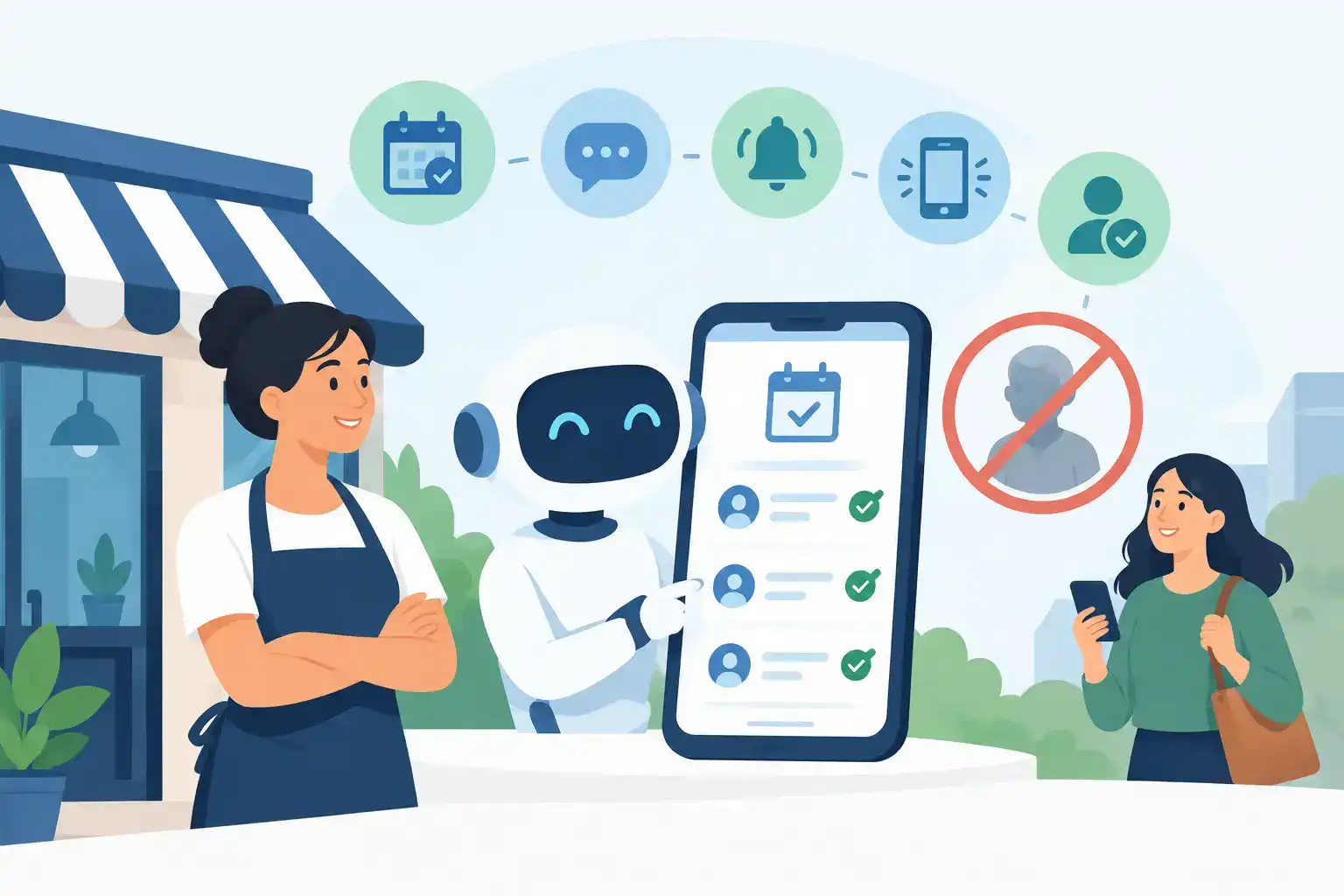
AI works best when it supports the whole attendance journey. That includes the booking confirmation, reminder timing, replies to common questions, rescheduling, and follow-up after a missed appointment. It is a practical system, not a magic button.
1. Write reminders people actually read
AI can create a set of short reminder messages that sound like your business, not a robotic call center. You can ask ChatGPT to produce versions for text message, email, and WhatsApp, then use the one that fits how your customers normally communicate.
The difference is in the detail. A useful reminder confirms the appointment time, location or video link, what the customer needs to bring, and one clear action: confirm, reschedule, or ask a question. For a chiropractor, that might include a note to arrive five minutes early. For a beauty therapist, it could mention patch-test requirements or a late-cancellation policy.
Avoid making every message long. AI can help you say more with fewer words, which matters when customers are glancing at a text between errands.
2. Send reminders at the right moment
One reminder 24 hours before an appointment is a good starting point, but it will not suit every business. AI can help you look at your own booking patterns and decide when to send a confirmation request, a day-before reminder, and a same-day nudge.
A customer booked two weeks ahead may need an early confirmation message. A barber shop with mostly same-week bookings may get better results from a 48-hour reminder and a message two hours before the slot. If your appointments require travel, preparation, or childcare, earlier reminders make more sense.
You do not need advanced software to begin. Export a few months of appointment data, remove personal details, and ask AI to spot patterns. Are Monday mornings missed more often? Do new clients fail to show more than repeat clients? Are certain services more likely to be canceled late? That information helps you stop guessing.
3. Make rescheduling easier than disappearing
Customers often no-show because rescheduling feels awkward or inconvenient. They intend to contact you, get distracted, and then feel embarrassed when the appointment time passes.
AI-powered booking tools and automated messages can give customers a direct rescheduling option before they reach that point. Your reminder can say, “Need a different time? Reply CHANGE and we will send available options.” If your booking system supports it, the message can take them straight to open slots.
This protects revenue in two ways. First, a moved appointment is better than an empty slot. Second, when the change happens early enough, you may be able to offer the opening to someone on your waitlist.
Keep some human judgment here. A long-term client with a genuine emergency may deserve flexibility. A customer who repeatedly shifts bookings at the last minute may need a deposit or a different booking policy. AI can flag the pattern, but you decide what is fair.
4. Use AI to manage a waitlist faster
A cancellation does not have to remain a loss. AI can draft and trigger a short message to suitable waitlist customers based on service type, location, preferred days, and availability.
For example, if a 3:00 p.m. facial appointment opens tomorrow, the right message goes to clients who have previously asked for afternoon slots or indicated they can come in on short notice. Instead of manually scrolling through old conversations, you have a faster process for filling the gap.
Do not send every opening to everyone. That quickly becomes noise. Start with a small, relevant group, give them a clear deadline to claim the slot, then widen the offer if needed. AI helps with the matching and wording, while your booking rules keep the process organized.
5. Reply to appointment questions before they become excuses
Many missed appointments begin with a small unanswered question. Where do I park? Can I bring my child? What happens if I am 10 minutes late? Do I need to complete paperwork first?
An AI-assisted inbox can identify these common questions and prepare accurate reply templates for your approval. That means customers get reassurance quickly rather than leaving the question unresolved and deciding not to attend.
Build a simple knowledge file for AI with your opening hours, address, parking details, cancellation policy, service preparation instructions, and contact details. Review every template before using it, especially if you work in health, wellness, or another regulated field. AI should never invent clinical advice, pricing, or policy exceptions.
6. Identify repeat no-show risks early
Not every booking carries the same risk. A first-time customer who booked late at night, has not confirmed, and has missed before may need more attention than a regular who has attended 20 times.
AI can help score bookings using simple signals you already have: confirmation status, lead time, previous attendance, appointment value, and booking channel. This does not need to become a complicated algorithm. Even a weekly review that highlights unconfirmed, high-value appointments gives you a useful action list.
For higher-risk bookings, you might request a deposit, send an extra confirmation message, or make a brief personal call. The point is not to treat people with suspicion. It is to use your limited time where it can prevent the biggest losses.
Be thoughtful about privacy and fairness. Do not feed sensitive customer records into a public AI tool without understanding how that data is handled. Remove names, phone numbers, health details, and other identifying information when you are analyzing trends. Use the minimum data needed to make a better operational decision.
7. Follow up after a missed appointment without sounding hostile
The message after a no-show can decide whether a customer returns or quietly disappears for good. AI can help write a follow-up that is firm, polite, and consistent with your policy.
A good message acknowledges the missed appointment, explains the next step, and makes rebooking straightforward. It does not need a lecture. For example: “We missed you today. If you would like to rebook, reply here or use your usual booking link. Please note that our missed-appointment policy applies to this booking.”
Create separate templates for a first no-show, a repeat no-show, and a customer who contacted you afterward with a legitimate reason. Consistency matters, but so does context. This is where AI saves writing time while you retain control over the relationship.
A simple prompt to build your reminder system
If you use ChatGPT, start with one focused request rather than asking it to “reduce no-shows.” Give it the information it needs and ask for messages you can actually use.
> Act as an appointment communications assistant for my [business type]. Create a three-message reminder sequence for customers with appointments. Message one goes out [time] before the appointment, message two goes out [time] before, and message three goes out [time] before. Use a friendly, professional tone. Include the appointment time placeholder, a simple confirmation request, and a clear rescheduling instruction. Keep text messages under 160 characters. Our cancellation policy is: [paste policy]. Do not make promises or add information I did not provide.
Review the output, adjust the language to sound like you, and test it for two weeks. Track confirmations, cancellations, reschedules, and no-shows before changing five things at once.
Start with the booking leak that costs you most
You do not need an elaborate AI setup to see a result. Pick one weak point – perhaps customers failing to confirm or canceled slots going unfilled – and build one repeatable workflow around it. Once that is working, add the next step.
That is the useful side of AI for small businesses: reassurance, not hype. A better reminder, a quicker reply, or one recovered appointment can pay for the effort. Then you get to spend less time chasing people and more time serving the customers who show up.