Aftercare Message Templates for Clients That Work
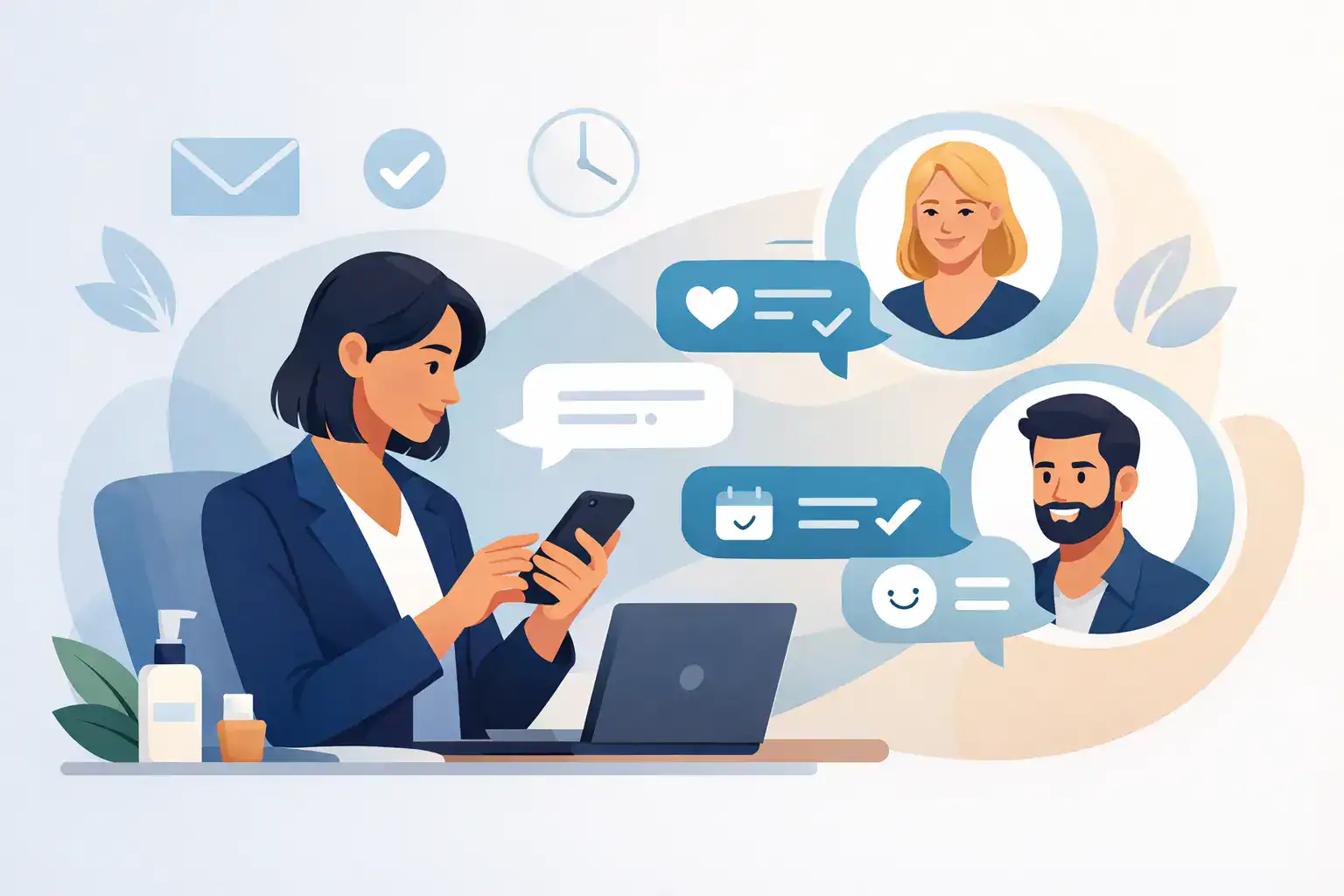
A client leaves happy, then sends a worried message at 9:42 p.m. asking whether redness, soreness, or sensitivity is normal. You could reply from scratch again. Or you could use aftercare message templates for clients that give the right reassurance at the right time, without turning your evening into unpaid admin.
For a small service business, aftercare is not a nice extra. It is part of the customer experience. A clear message reduces uncertainty, helps clients follow your instructions, and makes your business feel organized long after the appointment ends. It can also cut down on repeat questions, missed follow-ups, and avoidable complaints.
The goal is not to sound automated. The goal is to stop rewriting the same useful advice while still sounding like a real person who cares.
Why aftercare messages earn their place in your workflow
Clients rarely remember every verbal instruction you give them at the end of an appointment. They may be distracted, rushing to pick up their kids, or processing information after a treatment. A short written follow-up gives them something they can check later.
That matters whether you run a beauty business, wellness practice, tattoo studio, chiropractic office, or another appointment-based service. The details change, but the pattern is the same: clients need clarity on what to do next, what is normal, and when to contact you.
A good aftercare message also protects your time. Instead of manually answering the same question ten times a week, you send a helpful starting point once. You are not hiring a single extra employee to make your follow-up feel more professional. You are simply building a repeatable system.
There is a trade-off, though. Templates should never replace professional judgment. If a client describes severe symptoms, an allergic reaction, unusual pain, or anything that concerns you, a generic message is not enough. Your template should make it easy for clients to know when they need direct support or medical advice.
What every client aftercare message should include
The strongest messages are short enough to read and specific enough to act on. Start by thanking the client or checking in after their visit. Then give the two or three most important care instructions rather than dumping a full manual into a text.
Next, set expectations. Tell them what mild, expected effects may look like, if appropriate for your service. Finally, explain what to do if they have questions or something does not feel right.
Keep the tone calm. “Please avoid X for 24 hours” works better than a wall of capital letters and warnings. You want reassurance, not hype and not panic.
For regulated, medical, or high-risk services, make sure every template has been checked against your own policies, insurer requirements, and local rules. AI can help draft the wording, but it should not invent clinical instructions or replace a qualified professional’s guidance.
5 aftercare message templates for clients
Use these as starting points, then replace the bracketed sections with your own service details. Save them in your booking software, phone notes, CRM, or a text-expander tool so they are ready when you need them.
1. The same-day check-in
Hi [First Name], thanks again for coming in today for your [service]. Just a quick reminder to [most important aftercare step] and avoid [activity or product] for the next [time period]. It is normal to notice [mild expected effect], but please message us if you have any concerns. Take care, [Business Name].
This is the best all-purpose template because it lands while the appointment is still fresh. Send it within an hour or two, not three days later when the client may already be confused.
2. The next-day reassurance message
Hi [First Name], just checking in after your [service] yesterday. How are you feeling? Please continue to [key instruction] today, and remember that [expected effect] can be normal during the first [time period]. If anything feels unusual or you are worried, reply here and we will point you in the right direction.
This works well for services where clients may experience mild delayed discomfort, dryness, swelling, or sensitivity. It shows care without requiring you to start a long conversation with every client.
3. The detailed care reminder
Hi [First Name], here is your quick aftercare reminder for [service]: [instruction one]. [Instruction two]. [Instruction three]. Please avoid [avoidance] until [time or condition]. If you are unsure about anything, reply to this message before trying a new product or treatment. Thanks, [Business Name].
Use this when there are a few non-negotiable instructions that clients commonly forget. It is particularly useful after treatments with products, healing periods, or activity restrictions. Keep it to three instructions where possible. If you have more, send a separate care sheet through your normal approved process rather than creating an unreadable text block.
4. The progress check-in
Hi [First Name], it has been [number] days since your [service], so we wanted to check that everything is settling well. By now, you may notice [normal progress marker]. Please keep following the aftercare advice, and contact us if you have questions about your results or next steps.
A timed check-in feels thoughtful and can spot issues before frustration grows. It is also a natural place to mention a follow-up appointment when that is genuinely part of the service, not as a pushy sales message.
5. The follow-up and rebooking message
Hi [First Name], we hope you are happy with your [service]. To maintain your results, we usually recommend booking your next [service or check-in] around [time frame]. If you need help choosing the right timing, reply here and we will help. Thank you for choosing [Business Name].
This message should come after the core aftercare period, not immediately after the appointment. Clients can tell when a business jumps straight from “How are you?” to “Book again.” Care first, then a useful next step.
How to make templates sound personal, not copied
Personalization does not mean manually writing every message. It means using the details that matter. A first name, the exact service, one relevant instruction, and the right send time usually do more than adding five cheerful emojis.
Build variations for your most common appointment types. A facial client needs different guidance than a lash client. A chiropractic patient may need a different check-in sequence than someone who bought a retail product. Do not force one template to cover every situation just because it is convenient.
You should also decide who sends each message and when. If you are a sole trader, that may be you using scheduled messages. If you have a small team, agree on the wording and timing so clients receive consistent advice regardless of who performed the service.
Before automating anything, send the messages manually for a week or two. You will quickly learn which questions still come back, which instructions clients overlook, and where your wording is too vague. Then improve the template before placing it on autopilot.
Use ChatGPT to build safer, faster first drafts
ChatGPT can help you turn your existing aftercare notes into clear client-friendly messages. The key is to give it the actual facts you already use, rather than asking it to create advice from nothing.
Try this prompt:
> Write three SMS aftercare messages for clients after a [service]. Use the following approved instructions: [paste instructions]. Keep each message under 320 characters, warm and clear, with no medical claims. Include what is normal, what to avoid, and when to contact us. Do not add advice that is not in my instructions.
Then review every output. Check timing, terminology, character length, and any claims that could create risk. AI is excellent at removing the blank-page problem and producing alternatives quickly. It is not the person responsible for your client’s care or your business policy.
For sensitive services, avoid pasting private client health details into public AI tools. Use placeholders such as [client concern] or [treatment type], and follow your privacy obligations before using any software in your workflow.
A small system that saves hours
Start with just three messages: same-day instructions, next-day reassurance, and a later progress check-in. That is enough to create a better experience without building a complicated automation project you never finish.
Save the approved versions in one place, review them every few months, and update them when your service, products, or policies change. The best aftercare system is not the fanciest one. It is the one your business actually sends, consistently, when clients need it most.
A clear message after an appointment tells clients they have not been forgotten. That kind of reliability is easy to remember, easy to recommend, and far more valuable than another hour spent fumbling for the right reply.



Discover high-quality resources for your next project at machine learning data, offering curated, ready-to-use collections for research and development.
It is critical that teams record origin, methods of acquisition, and known limitations.
Different tasks require tailored dataset structures and labeling schemes. Text datasets for NLP require careful handling of tokenization, context markers, and annotation standards.
Ethical and legal considerations shape dataset creation and sharing policies. Publicly available datasets spur research but should include protections for individuals.
Evaluation datasets and benchmarks enable objective comparison of models. Thoughtful evaluation datasets help identify model limitations and measure performance consistently.
Artificial intelligence datasets form the backbone of modern machine learning research and applications.
Discover high-quality resources for your next project at free datasets, offering curated, ready-to-use collections for research and development.
Datasets for AI serve as the primary fuel that powers machine learning models to recognize patterns and infer outcomes.
Different tasks require tailored dataset structures and labeling schemes. Language data collections must consider token boundaries, contextual tags, and consistent labeling conventions.
Ethical and legal considerations shape dataset creation and sharing policies. Publicly available datasets spur research but should include protections for individuals.
Evaluation datasets and benchmarks enable objective comparison of models. Ongoing updates to datasets are needed to track changing domains and emerging patterns.
AI datasets provide the essential examples that enable algorithms to learn patterns and make predictions.